

Window Barking: Why It Starts and How to Stop the Habit

Window barking is one of those dog behaviors that can start small and become a full-time household habit before owners realize what happened.
At first, it may just be a few barks when someone walks by. Then it turns into barking at every dog, delivery truck, neighbor, car door, skateboard, leaf blower, or person passing the house. Before long, the dog has assigned themselves a job: watch the window, scan for movement, and alert the entire household.
The frustrating part is that many owners think their dog is “just being protective” or “just looking outside.” But for many dogs, window barking becomes a rehearsed behavior pattern. The more they practice it, the stronger and more automatic it becomes.
The good news? With the right structure, boundaries, and consistency, window barking can improve.

Why Dogs Start Barking Out the Window
Window barking usually starts because something outside catches the dog’s attention.
That might be:
People walking past the house
Dogs passing by on leash
Cars, bikes, scooters, or skateboards
Delivery drivers
Neighbors moving around
Kids playing outside
Other animals
Sounds from the street or sidewalk
From the dog’s point of view, the window is exciting. It gives them constant access to movement, noise, and activity they cannot actually interact with.
That creates frustration.
The dog can see the person, dog, or car, but they cannot reach it. They cannot investigate it. They cannot control it. So they bark.
And then something interesting happens: the thing outside eventually leaves.
To the dog, it may feel like:
“I barked, and the person went away.”
Even though the person was already going to walk past the house, the dog may connect their barking with the outside trigger disappearing. That can make the barking feel rewarding.
Over time, the dog starts believing their job is to make everything outside go away.
The Problem With Rehearsed Barking
The biggest issue with window barking is repetition.
Every time your dog runs to the window, locks onto something outside, barks intensely, and watches the trigger leave, the habit gets stronger.
That repetition teaches the dog:
The window is their post
Outside movement is their responsibility
Barking is the correct response
Big reactions make things disappear
Calm behavior is not required
This is why window barking often gets worse instead of better on its own.
A dog who barks out the window once or twice may not seem like a big deal. But a dog who practices that behavior every day, multiple times a day, is building a very strong pattern.
That pattern can also spill into other areas of life.
A dog who constantly reacts to dogs through the window may become more reactive on leash. A dog who barks at people outside may become more suspicious of visitors. A dog who spends all day scanning the neighborhood may struggle to settle inside the house.
Window barking is not always just a window problem. It can become a mindset problem.
Why “Looking Outside” Isn’t Always Relaxing
Many owners leave blinds open because they think their dog enjoys watching the world.
And some calm, neutral dogs can look out a window without becoming worked up.
But for other dogs, window access is not relaxing at all. It is overstimulating.
Instead of calmly observing, the dog is:
Scanning
Staring
Pacing
Whining
Barking
Scratching at the window
Running from window to window
Waiting for the next trigger
That is not entertainment. That is mental escalation.
For dogs who are reactive, anxious, territorial, easily frustrated, or highly alert, the window can become a source of constant stress.
They are not calmly enjoying the view. They are working themselves up over and over again.
Common Mistakes Owners Make With Window Barking
One common mistake is yelling at the dog from across the room.
The dog barks. The owner yells, “No!” or “Stop!” The dog may stop for a second, but then they go right back to barking.
Why? Because yelling often adds more excitement to the moment. The dog is already worked up, and now the owner is worked up too.
Another mistake is allowing unlimited window access all day. If the dog has free access to the window whenever they want, they also have unlimited chances to practice the behavior.
Some owners try to distract with treats after the dog has already exploded. While food can be useful in training, timing matters. If the dog is already barking intensely, the treat may not teach calm behavior. It may simply interrupt the barking for a moment without changing the habit.
The biggest mistake is waiting for the dog to “grow out of it.” Most dogs do not grow out of rehearsed behavior. They grow deeper into it.
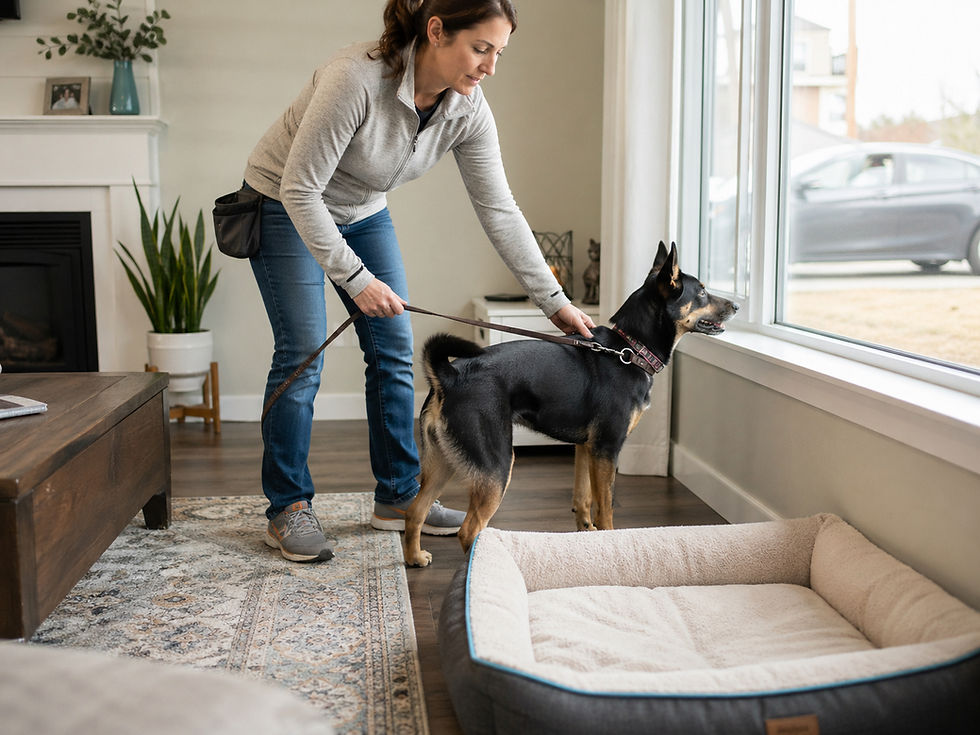
Step One: Block the Rehearsal
The first step to fixing window barking is reducing the dog’s ability to practice it.
That does not mean your dog can never look outside again. It means they should not have free access to rehearse barking all day.
You can start by:
Closing blinds or curtains during high-traffic times
Using privacy window film on lower windows
Moving furniture away from windows
Blocking access to front-facing rooms
Using gates, crates, or place beds to create structure
Supervising window time instead of allowing unlimited access
This part is important because training is much harder when the dog keeps practicing the unwanted habit between training sessions.
Think of it this way: you are not just trying to stop barking in the moment. You are trying to stop the pattern from getting stronger.
Step Two: Teach an Alternative Job
Dogs do better when they know what to do instead.
If your dog’s current job is “run to the window and bark,” you need to replace that with a clearer job.
A great option is teaching a place command.
Instead of allowing the dog to rush the window, you guide them to a dog bed, cot, or designated place and teach them to settle there.
The goal is not just physical stillness. The goal is emotional regulation.
Your dog learns:
“Movement outside does not mean I need to react. My job is to stay calm and follow direction.”
At first, this may need to be practiced when there is not much happening outside. Start easy. Build the skill before expecting your dog to handle the hardest triggers.
Step Three: Interrupt Early, Not Late
Timing matters.
Once your dog is already barking intensely, they are harder to reach. Their brain is locked onto the trigger, and they are already in reaction mode.
The best time to interrupt is before the explosion.
Watch for early signs like:
Ears going forward
Body stiffening
Staring out the window
Quiet growling
Fast movement toward the window
Tail height changing
Fixation on a sound outside
That is your window of opportunity.
Calmly interrupt, give direction, and move the dog away before they fully commit to barking.
The goal is to catch the thought before it becomes the habit.
Step Four: Use Structure Throughout the Day
Window barking often improves when the dog has more structure in the home overall.
A dog who has full freedom all day, no boundaries, and constant access to stimulation may struggle to turn off. They may feel responsible for managing the environment.
Structure helps remove that pressure.
That might include:
Scheduled crate or rest time
Place command practice
Leash guidance inside the home when needed
Clear rules around windows and doors
Calm transitions after walks or play
Less free roaming during high-alert times
This is especially important for dogs who are reactive, anxious, pushy, territorial, or easily overstimulated.
The more your dog learns how to relax inside the home, the less likely they are to patrol the windows looking for something to react to.
Step Five: Don’t Let the Window Be the Most Exciting Part of the Day
Some dogs become obsessed with window watching because they are mentally under-stimulated.
That does not mean they need constant activity. In fact, too much excitement can make the barking worse.
What they need is appropriate structure and productive outlets.
Helpful activities may include:
Structured walks
Obedience practice
Place command work
Calm leash drills
Threshold work at doors
Recall practice
Supervised exposure to mild distractions
Teaching calm behavior after activity
The goal is not to exhaust the dog into silence. The goal is to create a dog who knows how to think, respond, and settle.

When Window Barking Becomes Reactivity
Window barking can be more serious when the dog is reacting intensely to dogs, people, or specific triggers.
Signs that the behavior may be connected to reactivity include:
Barking that sounds frantic or aggressive
Lunging at the window
Scratching or jumping at glass
Redirecting onto other dogs in the home
Staying worked up long after the trigger is gone
Becoming more reactive on walks
Guarding windows, doors, or entry points
In these cases, the issue is usually not just noise. The dog is practicing a heightened emotional response.
That is where professional training can make a big difference. The dog may need help learning impulse control, leash manners, calmness, boundaries, and better decision-making around triggers.
The Goal: A Calmer Dog Inside the Home
Stopping window barking is not about expecting your dog to never notice anything.
Dogs will notice movement. They will hear noises. They may alert from time to time.
The goal is to prevent barking from becoming a rehearsed lifestyle.
A well-trained dog can notice something outside without spiraling. They can be redirected. They can settle. They can trust that every person, dog, car, or delivery driver is not their responsibility.
That kind of calm does not happen by accident. It comes from consistent structure, clear expectations, and removing the dog’s ability to practice the wrong behavior over and over again.
Final Thoughts
Window barking may seem like a small household annoyance, but for many dogs, it becomes a deeply rehearsed habit.
The more your dog practices scanning, reacting, and barking at neighborhood movement, the more natural that behavior feels to them.
To change the habit, you have to change the pattern.
Limit access. Interrupt early. Teach an alternative behavior. Build calmness. Add structure. Stop allowing the window to be your dog’s full-time job.
At San Diego Dog Training, we help dogs learn how to be calmer, more responsive, and easier to live with in everyday home situations. Whether your dog struggles with barking, reactivity, overexcitement, leash manners, or boundaries, the right training can help create a more peaceful home for both you and your dog.


Comments